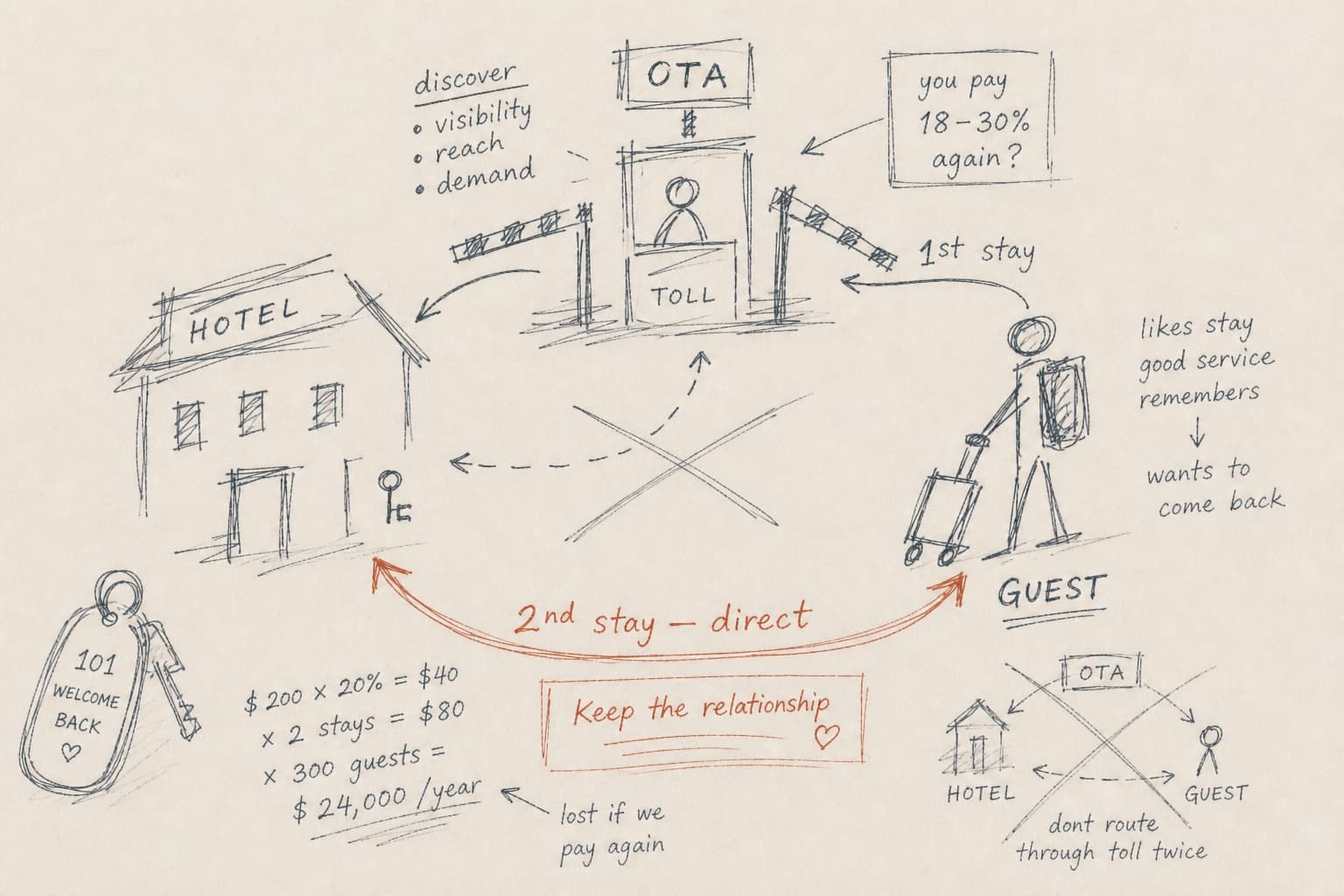
Direct Booking Recovery
A working model for helping independent hotels turn first-time OTA guests into direct repeat customers.
This public working paper is based on a published V1 episode. It is not an approved V2 Canvas. What that means
Start here
The case in three decisions.
Read these first. Use the working paper for the evidence, assumptions, economics, and stop conditions behind each answer.
- 01Is the problem worth solving?
Independent hotels pay for discovery, then often pay again to reach a guest they already served.
Observed premise - 02Can one operator deliver it?
The entry offer combines booking-path repair, guest permission, return campaigns, and measurement for one property.
Modeled offer - 03What should be tested first?
Use one property's baseline to test whether direct share moves. Stop if activity rises and the outcome does not.
Modeled test · unknown result
Explore the working paperGuided walkthrough off
00 / Opportunity
Is the problem worth solving?
OTAs do discovery well. The opportunity appears when the hotel pays again to reacquire a guest it has already served.
What already works
The first booking can come through an OTA. Distribution gives an independent property reach it could not efficiently reproduce alone.
What the operator changes
Earn the second booking direct through permission, useful guest context, a relevant reason to return, and a destination that completes the promise.
- Entry wedge. One property: install the recovery stack and measure its direct share.
- Proof before expansion. The property's direct share moves against its own baseline.
- Aspirational destination. A guest-relationship practice serving independent properties.
01 / System
What must one operator run?
A business is more than a collection of tools. These capabilities describe the recurring work, the inputs it needs, and the judgment that cannot be automated away.
01 · Find
- Human judgment
- Approve what is true and current
- Implementation
- Google Business Profile · OTA listings
- Failure mode
- Inconsistent or stale promises
02 · Convert
- Human judgment
- Own exceptions and guest experience
- Implementation
- Hotel site · booking engine · phone
- Failure mode
- Outreach sends demand into a broken path
03 · Remember
- Human judgment
- Approve consent, context, and tone
- Implementation
- Guest list · CRM · permission record
- Failure mode
- Privacy breach or generic outreach
04 · Return
- Human judgment
- Choose the offer and approve the message
- Implementation
- Email delivery · workflow automation
- Failure mode
- Discounting without relationship value
05 · Measure
- Human judgment
- Interpret the result and redesign the flow
- Implementation
- Booking reports · monthly scorecard
- Failure mode
- Activity rises while the outcome stays flat
02 / Evidence
What do we know, and what remains uncertain?
Evidence earns the right to keep investigating. It does not turn an illustrative model into a property-specific result.
Unknown register · open questions carried, not hidden
U001
What a hotel will pay for this specific service. Five providers were scanned; no public price was found. A first paid conversation would test it.
UnknownU002
Delivery hours per property at a defensible standard. Measure this in the first engagement.
UnknownU003
Whether a property renews after the first measured period. Track this after the first quarter.
Unknown03 / Economics
Could the economics work?
The market pressure, hotel model, and operator workload answer different questions. Read them side by side; never collapse them into one revenue claim.
18–30%
All-in Booking.com commission range reported when loyalty and visibility programs are included.
- Base commission
- Included
- Visibility programs
- Included
- Property result
- Unknown
$135K/yr
Arithmetic estimate of annual commission exposure. Not a reported hotel result or a universal loss figure.
- Rooms × ADR
- 20 × $180
- Occupancy × OTA share
- 70% × 63.4%
- Commission
- 22%
Unknown
Public provider pricing does not establish what a hotel will pay for this service.
- Providers scanned
- Five
- Delivery capacity
- Test
- Renewal threshold
- Measure
04 / Guardrails
What should you test first?
The first engagement should reduce uncertainty, not hide it. Establish the baseline, repair the destination, respect permission, and define the result that would justify continuing.
Start with permission and a baseline
- Measure booking mix, commission, cancellations, missed calls, and repeat stays.
- Repair the mobile booking and phone path before running outreach.
- Begin with past guests who have permission to hear from the property.
- Track direct share before and after; use other metrics to diagnose the path.
Stop or redesign when
- The property cannot establish a credible baseline.
- Guest permission or data access is unclear.
- The destination cannot complete the promise.
- Activity rises while direct share does not move.
Supporting material
Watch the investigation.
Watch №006 on YouTube (opens in new tab)
Episode
Hotels pay 30% to book their own rooms · live · Aug 2026
Format
Published under the earlier V1 Blueprint regime.
Transcript
Captions are available on YouTube.
05 / Download
Take the legacy Blueprint with you.
The existing V1 PDF remains available as the historical companion to the episode. It is not a gated or V2 Canvas edition.
Downloading does not subscribe you to the newsletter.