A way to decide before you commit.
An Operator Canvas turns a business opportunity into a decision you can inspect. It shows what is known, what is assumed, what one person would have to run, and what to test first.
Why this exists
AI made more businesses possible. It did not make them worth building.
One person can now deliver work that once required a team. That changes the minimum viable size of a business, but it does not prove demand, defensibility, capacity, or economics. The Operator Canvas exists to test those questions before the story makes the opportunity feel inevitable.
What the Canvas answers
Three decisions, in a useful order.
The Canvas is not a score or a promise. It gives you enough structure to test, revise, or reject the opportunity.
- 01Is the problem worth solving?
Who has the problem, why it matters now, what the operator sells, and what result the buyer is purchasing.
- 02Can one operator deliver it?
The recurring workflow, tools, human judgment, price, costs, capacity, and customer count.
- 03What should I test first?
The weakest assumption, a bounded 30-day test, a success signal, and a stop condition.
How claims are marked
Facts, transfers, assumptions, and unknowns stay distinct.
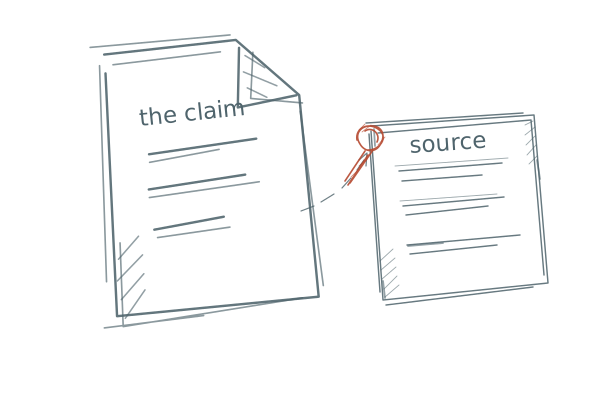
The label beside a claim tells you what kind of support it has. The source or arithmetic sits with the claim, not in a distant appendix.
A sourced fact. The receipt names who measured or reported it.
ObservedEvidence from a neighboring model. The Canvas states what transfers and what remains unproven.
ParallelAn assumption with its arithmetic shown. It is not presented as observed performance.
ModeledAn open question. The Canvas keeps it visible and says how the first test could resolve it.
UnknownHow it is made
Research first. Canvas second. Story third.
A compelling story cannot rescue an incomplete business model. The model is reviewed before the episode is produced.
- Research the opportunity. Identify the buyer, problem, delivery path, economics, risks, and a testable first offer.
- Build and challenge the Canvas. Attach evidence classes, expose unknowns, test capacity, and reject the opportunity if a required part does not hold.
- Lock the model. Material claims, assumptions, and disclosures are fixed before narration and production begin.
- Publish the investigation. The episode tells the story. The Canvas lets the reader inspect and use the model.
The standard
No income promises. No hidden assumptions. No polished answer where the evidence is incomplete.
Modeled economics are not observed performance or an earnings forecast. A failing case stays failed. A material edit creates a new revision. The public page contains everything you need to judge the opportunity; a PDF adds detail and print utility.
How revisions work
The current model never erases the prior one.
A material Canvas change creates a new dated revision. Its source, public data, and PDF each receive their own full hash. Earlier revisions remain available and clearly labeled.
Every published business uses the V2 Canvas format. The earlier V1 Blueprints were withdrawn on 12 October 2026 and are no longer published.
Canvas